Blog
Many of the manoeuvres we perform when riding a motorcycle carry a certain degree of risk. But among them, overtaking is one of the manoeuvres that can lead to the most serious consequences when it isn't judged correctly.
In our previous post, we mentioned that roughly 15% of motorcycle accidents happen during overtaking. So in this post, we'll look at why overtaking is dangerous, the key safety points to keep in mind when deciding to overtake, and the basic types of overtaking.
A motorcycle's high viewing position, agility and quick acceleration give the rider real advantages when passing a vehicle ahead. Add to that the narrow space a motorcycle takes up on the road, and you could think of the motorcycle as one of the best-suited vehicles for overtaking.
But that isn't always the case. During an overtaking manoeuvre, we move into a lane that isn't normally ours. Crossing into the opposite lane, especially on two-way roads, puts us directly into a potential danger zone.
What's more, when overtaking we're not just assessing the vehicle we want to pass. At the same time we must assess:
— all at once.
So overtaking isn't just about accelerating and passing the vehicle ahead. It's a complex riding manoeuvre that requires correct observation, correct timing, correct distance and the ability to make the right decision.
To better understand why overtaking needs to be handled with care, let's look at some striking statistics:
We should never forget that overtaking isn't a routine manoeuvre, and that a wrong judgement can lead to very serious consequences.
Remember that the overtaking manoeuvre is your own decision. No vehicle forces you to overtake.
The vehicle in front of you might be going slowly. You might have been following it for a while. Vehicles behind you might make you feel pressured. But despite all of this, the decision to overtake or not is entirely your responsibility.
Even more importantly, you can reconsider your decision even after you've started to overtake. When a new hazard appears, the right decision might be to abandon the overtake.
A good rider doesn't feel obliged to complete a manoeuvre they've started. When safety conditions change, they can change their decision.
When you've decided to overtake, you should always keep the following core safety principles in mind:
And perhaps the most important rule of all: if you're not sure, don't overtake! Sometimes the safest overtake is the one you never make.
We should remember that roads aren't used only by motor vehicles. We may encounter many road users on the road with different needs, moving in different ways. For example:
can all move unpredictably. We should always bear in mind that animals may startle, cyclists or children may suddenly change direction, and farm vehicles may behave differently from normal traffic flow.
That's why keeping sufficient distance from other road users during an overtake is extremely important. We should also carefully assess the road ahead: Is there a side road coming up? Is there an entrance or lay-by at the roadside? Does a hill or rise block our view? Could there be a junction ahead? Might the vehicle we're overtaking suddenly change direction? Could there be a faster vehicle approaching from behind?
When we move into the opposite lane to overtake, we're not just trying to pass the vehicle ahead. At the same time, we have to assess both the current hazards in front of us and the potential hazards that haven't yet appeared.
That's why a good motorcycle rider doesn't just react to what they see. They assess what they see, investigate what they can't see, and try to anticipate hazards that haven't yet developed as much as possible. In other words: we should expect the expected, and try to anticipate the unexpected.
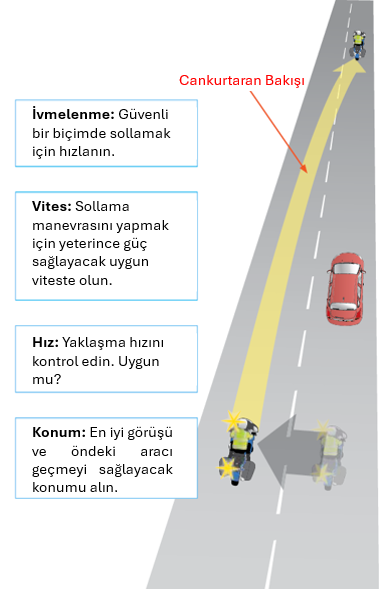
Applying the Motorcycle Control System correctly helps make the overtaking manoeuvre safer and more controlled. We'll cover the Motorcycle Control System in more detail in future posts.
Overtaking manoeuvres are assessed differently depending on road and traffic conditions. In this context, we can broadly talk about 2-stage overtaking and 3-stage overtaking.
2-stage overtaking is used when there's no other major hazard present, and the vehicle ahead can be passed safely in a single, smooth manoeuvre. In this type of overtake, generally:
When all of these conditions are met, the overtake can be carried out as a single, controlled manoeuvre after the necessary observations and checks.
3-stage overtaking is used when there are other potential hazards ahead of or around you, and you need to follow the vehicle ahead for a while before starting the overtake, to gather more information. For example:
In this case, the rider doesn't start overtaking immediately. Instead, they hold a safe following position, assess the road and their surroundings, and wait for the right conditions for overtaking to develop. Once there's sufficient visibility, sufficient distance and a safe space, the overtake is carried out.
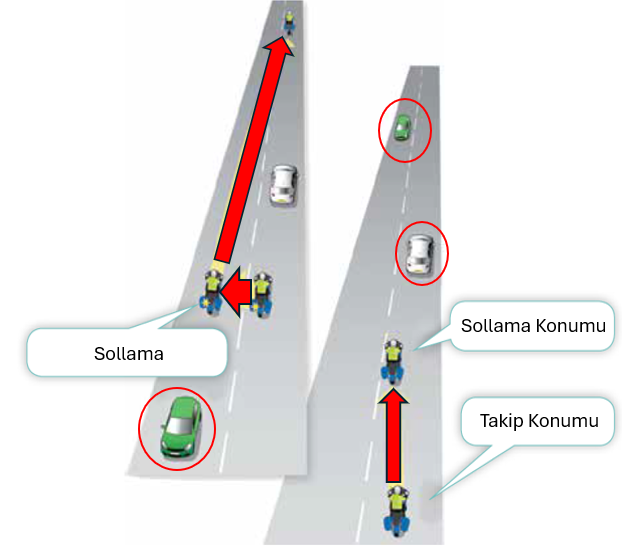
To sum up: an overtake carried out as a single, smooth manoeuvre, where all the necessary safety conditions already exist, is a 2-stage overtake. If other hazards mean you need to wait, follow, and assess further before overtaking, that's a 3-stage overtake.
In both cases, the goal is the same: make the decision to overtake with as much information as possible, and keep enough of a safety margin to abandon the manoeuvre if a new hazard appears.
In our previous post, we talked about the most common types of accidents motorcycle riders face. In this post, we've looked at one of the higher-risk manoeuvres: overtaking.
Overtaking can be carried out safely when the right conditions exist. But an overtake carried out in the wrong place, at the wrong time, or without sufficient observation can have irreversible consequences within seconds.
That's why we should always remember: overtaking is not an obligation. Sometimes waiting a few seconds, or even a few minutes, can be the safest riding decision you make in your whole life.
A good motorcycle rider isn't the one who decides fastest — it's the one who can make the right decision at the right time.
Remember... Safe riding starts with the right technique, and continues with the right decisions.